$18.29
$24.33
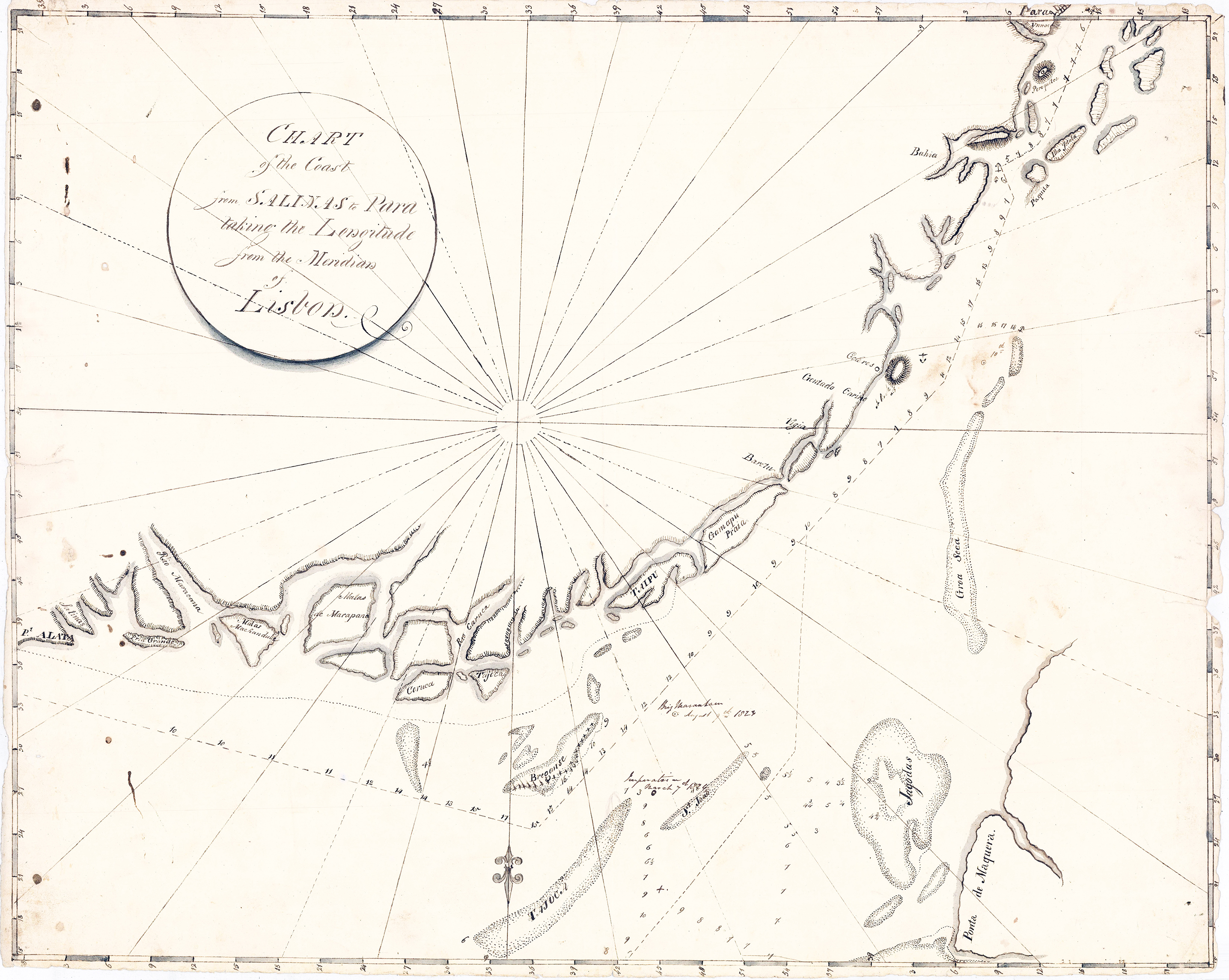
Description BRAZIL – AMAZON – BELÉM DO PARÁ / BRAZILIAN INDEPENDENCE ERA / ORIGINAL MSS. SEA CHART: Anon. Manuscript, Off the Coast of Brazil, [1823/4]. Manuscript, pen and ink and grisaille wash on fine wove paper watermarked ‘J. Whatman Turkey Mill 1821’ (Very Good, overall clean and bright with just some small stains, some minor marginal chipping and short closed tears from margins, old soft folds), 48 x 59.5 cm (19 x 23.5 inches). The city of Belém do Pará, which today has a metropolitan population of 2.5 million, has been for the last four centuries the gateway to the Amazon. It is located on the banks of the Rio Pará, a massive estuarine channel of the Amazon, 100 km up from the Atlantic. It was founded in 1616, becoming the capital of an impossibly vast and exotic inland empire called the ‘Captaincy of Grão-Pará’ that covered the territories of all the modern Brazilian states of Pará, Amazonas, Amapá, Roraima, and Rondônia. Belém grew into a large, bustling but gritty river port, exporting Grão-Pará’s vast quantities of tropical produce (sugar, rice, precious hardwoods, etc.) supported by an immense slave-plantation economy that extended hundreds of kilometres inland. Located a vast distance from the colonial centres of power (Rio de Janeiro was 2,500 km away, while Salvador da Bahia was 1,500 km distant), unlike the rest of Brazil, Grão-Pará’s government and trading stakeholders reported directly to Lisbon, which was eager to maintain control over its bounty. From 1750 to 1790, Belém do Pará prospered immensely, riding a constant and exuberant commodities boom. During the 18th century, British merchants became key players in Belém’s commodity and slave trades. This was even though all direct trade between Britain (and indeed any other foreign country) and Brazil was forbidden, a ‘detail’ that was circumvented by British commercial houses headquartered in Lisbon and Porto. The turmoil of the French Revolutionary and Napoleonic Wars severely disrupted Transatlantic trade and commodity markets, leading to Belém’s economic decline and a general social malaise throughout Grão-Pará. In 1808, when the Portuguese royal court was evacuated to Rio de Janeiro, in the wake of France’s invasion Portugal, Brazil (including Grão-Pará) was officially opened to direct British trade for the first time. This led to a resurgence in Belém’s economy, as the port welcomed numerous mercantile vessels from places such as Liverpool, London, Bristol and Glasgow. Here the British could acquire tropical goods for markedly lower prices that in other major Brazilian ports, while the locals benefitted from their visitors’ amble supply of specie and their willingness to extend loans on flexible terms (often using slaves as collateral). The British commercial activity in Belém’s port provided a vital ray of economic light into what was otherwise a gloomy environment in Grão-Pará. During the era of the Brazilian War of Independence (1821-2), Grão-Pará was gripped by political turmoil, as various rival factions sought to gain dominance in a place that was so distant from the rest of the action. Two main political options developed, with one calling for Grão-Pará to become independent of Brazil, while maintaining a special Transatlantic relationship with Portugal, while the second path called for the province to join an independent Brazil full-stop. The British merchants who frequented Belém’s port nimbly navigated these political cleavages, wishing not to betray their ancient ally, Portugal, while leaving the door open to forging a future with an independent Brazil. Eventually, through gunboat diplomacy, Grão-Pará joined Brazil on August 15, 1823, almost a year after the rest of the country formed the independent Empire of Brazil. The relative peace in the decade from 1823, saw a flourishing of trade out of Belém, with the visitations of British ships reaching unprecedented levels. Great British trading houses, such as George Henderson and Co. of Glasgow, opened large, fixed premises in the city, becoming anchors of the local economy, helping to cement Belém’s role as the gateway to the Amazon in the modern industrial era. Navigating the Rio Pará Estuary The navigation of the of shipping lanes to and from the open Atlantic up the Rio Pará to the port of Belém was famously treacherous, owing to the presence of giant, constantly shifting sandbanks and the immense force of the tides and currents. Traditionally, there were no decent printed sea charts of the Pará Estuary, a reality that was the result of Portugal’s policy of ‘cartographic secrecy’, which essentially forbade the publication of any such works. Visiting vessels were thus reliant upon the services of local pilots, which met incoming ships at Salinas, a small port near the southern mouth of estuary, before guiding them along the 100 kms up into Belém. While (as evidenced by the present work), naval officers and merchants sometimes made their own bespoke sondages of the Pará Estuary, which they drafted on manuscript charts for their own private use, these works had very limited circulation and a low survival rate. The Portuguese policy of cartographic secrecy was not a function of paranoia but effectively served for generations to protect Belém from foreign attack and black-market trade, as navigating the river was forbiddingly dangerous for the uninvited. It was only in the wake of the opening Brazil’s ports to international trade, from 1808, that the Portuguese (and later the Brazilian) authorities agreed to allow for scientific surveys of the coasts to be executed for the purpose of open publication. While the French Admiral Albin Reine Roussin scientifically surveyed most of Brazil’s key ports and stetches of coastline in 1819 and 1820, leading the publication of his masterly atlas Le pilote du Brésil, ou description des côtes de l’Amerique Meridionale (Paris, 1826), his coverage did not extend to the Amazonian Estuaries. The first decent, and thus safely useable, published chart of the Rio Pará Estuary, depicting the shipping lanes into Belém, was John William Norie’s A New Chart of the North Coast of Brazil from Maranham to Para with a sketch of the River Amazon, drawn from a late Portuguese Survey with additions by J.W. Norie, Hydrographer, &c. (first issued London: January 21, 1824), which featured the large inset ‘The Entrances to the River Para, with Adjacent Shoals & Dangers’. Please see a link to an 1828 second edition of this chart, courtesy of the University of Wisconsin-Milwaukee: https://collections.lib.uwm.edu/digital/collection/agdm/id/19630/ Naturally, Norie’s chart, which was largely based upon manuscript surveys by British merchant mariners, would not have been available for use at sea off the Rio Pará Estuary until late 1824 – at the earliest – such that before that point, visiting skippers would have had to rely upon pilotage and any manuscript charts that they may have been able to make, or acquire, to undertake the notoriously dangerous navigation. Subsequently, Norie’s work, in its various editions and derivates, became the standard chart of issue for the Rio Pará navigation for decades, although it still had to be combined with the use of pilots owing the river’s potent moodiness. The Present Manuscript in Focus This is an amazing survivor, being an original large-format manuscript working sea chart of the Rio Pará Estuary, clearly drafted by an anonymous British merchant mariner, in 1823/4, during the last gasp of the ‘manuscript era’ of navigation in the region, on the eve of the availability of Norie’s chart, and at the beginning of the heady days in the wake of Brazilian Independence and the revival of Belém’s commercial life. The chart, drafted attractively and crisply in pen and ink with grisaille wash, captures the Rio Pará navigation from a perspective of facing due south, such that the city of “Para” [Belém] is show at the head of the estuary, in the upper right corner, while the open Atlantic lies in the lower left. The estuary’s gates, “Pt. Alata”, on the south bank, is on the far left side, while “Ponta da Marquera”, on the north bank, on Marajó Island (which separates the Rio Pará from the main mouth of the Amazon), is in the lower right corner. Just past Punta Alata is “Salinas”, where most incoming vessels first met the local river pilots, while beyond the south bank forms a massive curve arching towards Belém. Near the mouth of the estuary the passage is guarded by four massive sandbanks, being “Breganse” [Bragança], “Tajuca”, “St. João” and “Jagodas”, all deadly hazards that could easily ensnare an unsuspecting ship, causing it to be ripped apart by the daily tidal surges. This working sea chart, which would have been drafted aboard ship, on scene, features accurate and practically useful navigational intelligence, predicated upon bespoke sondages and observations of the estuary. The chart marks the two main shipping channels that lead from the sea into the Rio Pará Estuary. The deepest channel, which runs through the middle, between the “Breganse” and “Tajoca” sandbanks, is marked by bathymetric soundings (in fathoms) the entire length of the trip to Belém. Soundings are also marked at the mouth of the northern channel, which runs between the St. João” and “Jagodas” sandbanks, with both tracks converging into one to run south of the “Gran Seca” bank, which lies in the mid-course of the estuary. It should be noted that while the middle channel was clearer and deeper, the northern channel was sometimes easier to use depending on the tidal flows. Additionally, along the way to Belém, numerous inlets, islands and the anchorage sites are marked, providing waypoints along the passage. While the chart is not explicitly dated, it is drafted on fine English wove paper watermarked ‘J. Whatman Turkey Mill 1821’, while additional details added to the chart, on scene, likely shortly after it was made, add further clues to the dating. Marked in between the tip of the “Tajoca” and “St. João” sandbanks is the note “Separation March 7th 1824”, perhaps referring to where two ships hitherto travelling together parted company, while a bit further along the way towards Belém is a note that reads “Brig Maranham August 9th 1824”, seemingly referring to where a ship of that name was encountered. The chart is an amazing artifact of from an exciting and transformative time in the Brazilian and maritime history, of the kind that scarcely survives to the present day. References: N/A – manuscript seemingly not recorded. Cf. [re: Valuable period accounts of sailing into the Rio Pará Estuary:] John PURDY, rev. Alexander G. FINDLAY, The New Sailing Directory for the Ethiopic or Southern Atlantic Ocean; including the coasts of Brasil, etc.,… (London: R.H. Laurie by J. Rider, London, 1844), pp. 183-8; William Henry Bayley WEBSTER, Narrative of a Voyage to the Southern Atlantic Ocean, vol. II (London: Richard Bentley, 1834), pp. 67-87.
Archives And Documents